At some point, the roles that once defined you begin to fall away.
Athlete.
Husband.
Provider.
Father.
And when divorce reshapes your home, when estrangement silences your phone, when aging removes the illusion of control—you are left with one question: Read More
Who am I now?
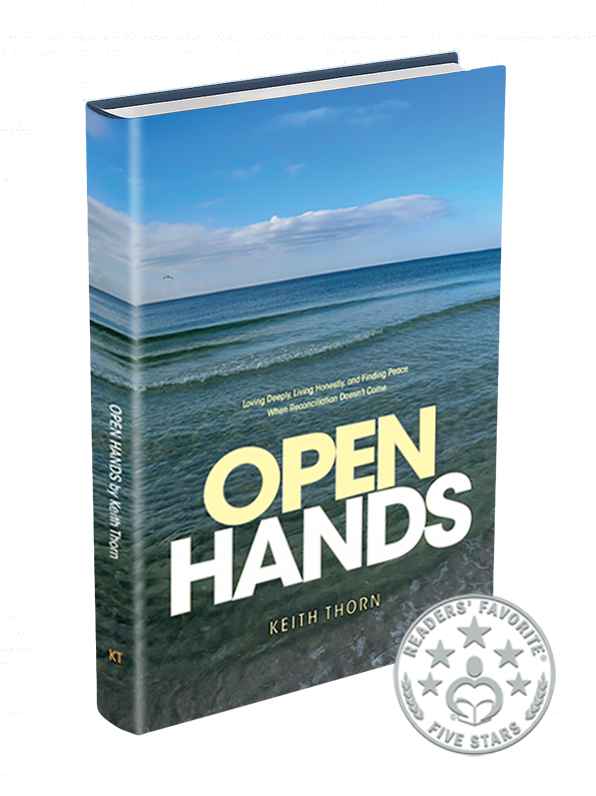
In Open Hands, Keith Thorn confronts that question without defensiveness or blame. He writes candidly about divorce, staying too long, choosing again, losing proximity to his children, and the quiet fear of dying without reconciliation.
But this is not a book about regret.
It is about responsibility.
It is about humility.
It is about faith that does not collapse when outcomes do.
Rooted in Christian conviction and lived experience, Thorn wrestles with identity beyond performance and worth beyond approval. He explores what it means to love adult children without control, to live visibly without hiding peace, and to trust God when reconciliation does not arrive on your timeline.
This book is for the father who feels misunderstood.
For the man whose roles have shifted.
For anyone asking whether peace is possible without resolution.
You are not your worst decision.
You are not your lost role.
You are not your silence.
You are known.
You are called by name.
You are loved.
And that changes everything.






Olivia –
OPEN HANDS is not a book about regret. It is a book about responsibility, humility, and faith that endures even when life does not unfold according to plan.
Keith Thorn writes candidly about divorce, estrangement, aging, identity, and the quiet fear of dying without reconciliation. He does not offer easy answers. Instead, he writes with the honesty of someone who has sat in the silence of a phone that does not ring and wrestled with questions that many parents carry but few are willing to voice.
What makes this book remarkable is its compassion—not only for those who have been hurt, but for those who have made mistakes and are still searching for peace. OPEN HANDS reminds readers that they are more than their worst decision, more than their lost role, more than their silence. They are known, loved, and called by name.
This is a deeply moving book for anyone navigating family estrangement, loss, faith, or the challenge of discovering who they are when the roles that once defined them begin to fall away.
tracysmith15 –
This book traces the author’s journey through divorce, inner conflict, and strained family relationships. A standout strength of the book is its exploration of internal narratives and how they shape identity. Thorn reveals how repeating self-critical beliefs can slowly transform into perceived truth, influencing decisions and relationships.
He also thoughtfully examines the cost of “staying too long” not just in marriage, but in any situation where fear is mistaken for commitment. These insights are not presented as lessons, but as realizations earned through lived experience, which makes them feel authentic.
By the end, Open Hands becomes less about loss and more about acceptance. The author embraces a mindset where love is no longer tied to control, proximity, or validation. His idea of keeping hands “open” reflects a willingness to remain loving and available without forcing outcomes or demanding closure.
It’s a thoughtful read for anyone seeking peace not through fixing everything, but through learning to let things be while still holding onto compassion.
Asher Syed –
Open Hands follows Keith Thorn as the wound left by the father who abandoned him continues to shape his life well into later adulthood, until the painful distance that forms between Keith and his own children forces him to face the fear that has guided his choices for decades. As he revisits the long-awaited apology from his dying father, Keith is brought to a spiritual reckoning in which he finally separates the absence of his earthly father from his understanding of God. In that awakening, he begins to see himself as a man whose worth does not rise or fall with marriage, estrangement, or the need to prove he is different from the person who left him. The memoir follows Keith’s movement toward a steadier life lived in faith and in continued readiness for his children’s return.
Keith Thorn’s Open Hands is a memoir that takes readers back through the experiences that led to an intensely personal reckoning in his sixties. This is a sweeping account that shows us how every step of Thorn’s journey shaped his life and those around him, often in situations he had little control over, and where he took that agency back to live life on his own terms. I admired his ability to recognize that staying in his second marriage was driven by fear, choosing to end it when he saw its effect on his children and the atmosphere. The elements of faith and Thorn’s identity are unmistakable, like when he describes praying over his children, and later believing his worth rests in God, especially when earthly fatherhood and divine fatherhood enter his understanding. Readers will benefit from Thorn’s portrayal of his estrangement, offering relatability to those living with distance, and how belief can restore an outlook of love, forgiveness, and hope.