Bad dreams feel real while they’re happening. Bad memories can feel the same—long after they’re over.
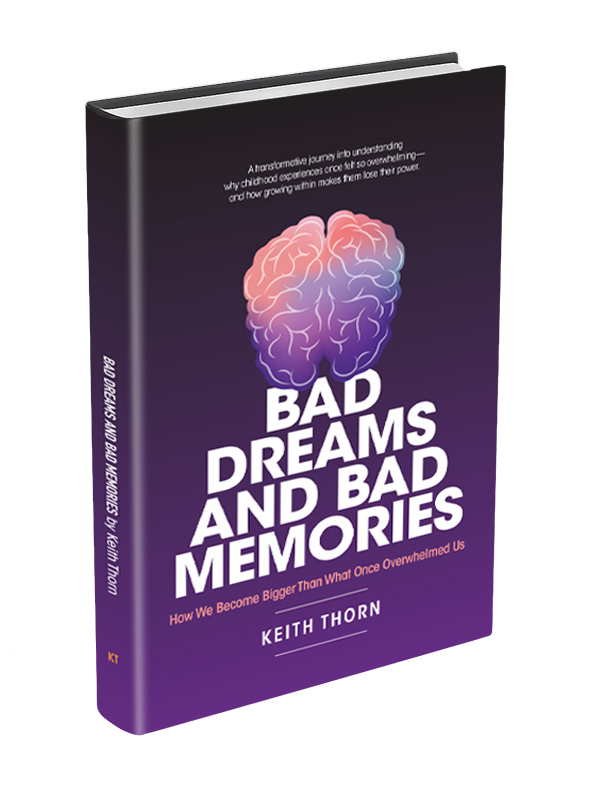
In Bad Dreams and Bad Memories, Keith Thorn explores a quiet but powerful truth: both dreams and memories occupy the mind, not the present. They borrow intensity from the past, but they no longer have authority—unless we give it to them. Read More
This book is not about reliving trauma or diagnosing pain. It is about understanding why certain childhood experiences once felt overwhelming, why they still echo in adulthood, and how growing within ourselves changes the scale of what we carry. As we expand, what once dominated us loses its power—not because it disappears, but because it no longer defines us.
Through reflective prose and lived insight, Thorn shows how memory, fear, and identity can loosen their grip when we stop mistaking what is remembered for what is real. The result is not emotional erasure, but presence—learning how to live fully in the life that continues now.
This is a book for anyone who has:
Been shaped by experiences they couldn’t name at the time
Woken from dreams that felt convincing and heavy
Carried memories longer than they deserved to stay in control
Wondered why the past still feels close, even when life has moved on
Bad Dreams and Bad Memories offers no formulas and makes no promises. Instead, it offers something quieter and more enduring: a way to recognize where you are, what is no longer happening, and how to live without being led by echoes.
Every once in a while a book comes along that speaks to you, like it was written for you – Bad Dreams and Bad Memories, by Keith Thorn, is one of those books. Unless you have lived a perfect life, with no pain in your past, this book might not connect with you, but otherwise, it is a brilliantly written work that touches deep into the quintessential essence of who we are and how our memories affect us. More to the point, and what makes this book so valuable is that the author presents an approach to dealing with them, not through denial or anything, but rather, coming to see our past as part of the learning curve of life, reconfiguring our past memories into a narrative that no longer defines us. Beautifully and softly written, the author shows, in so many ways, how to free oneself from the pain, not by forgetting it, but by realizing that we adapted to that pain at a time in our lives when we had no other way of dealing with it. Through his wonderful prose, he coaxes one out of the cave of darkness and into the light, to see that one’s past no longer controls who we are today.
This quotation depicts his message:
“You are no longer trying to escape your history.
You are learning how to carry it without being
shaped by it.
And in doing so, you are stepping into a freedom
that does not deny the past, but transcends it.”
A book that enriches one’s life and highly recommended.
Rated 5 out of 5
booksforreaders25 –
The book opens with a powerful metaphor, comparing bad memories to bad dreams. Thorn’s writing draws readers into a shared human experience of being unexpectedly pulled back into old emotions. The book unfolds as a series of thoughtful reflections.
The past only holds power when we remain the same size we were when we experienced it. Thorn repeatedly emphasizes growth, not as something dramatic, but as a gradual expansion of inner capacity that allows us to “outgrow” the emotional weight of earlier experiences.
The author gently guides readers toward understanding that memories do not need to be erased or fixed; they simply need to be seen in proper proportion. Through themes of self-awareness, emotional maturity, and presence, the book encourages readers to shift from reacting to old patterns to responding from a grounded, present self.
This book is less about overcoming the past and more about redefining one’s relationship with it. It is an insightful read. I am glad to get my hands on it. Add it to your tbr without any second thoughts.
Rated 5 out of 5
Asher Syed –
In Bad Dreams and Bad Memories, Keith Thorn explains how these two issues continue to influence everyday reactions when the body responds to stored impressions, as if those earlier conditions still exist. He tells us that these responses begin before conscious thought and reflect patterns formed when our understanding was limited. Thorn talks about how change occurs when a person recognizes the difference between memory and present conditions, remaining grounded during triggered moments instead of following automatic reactions. Through repeated exposure to present safety, the body adjusts its responses to match current reality. As this process develops, behavior reflects present capacity, and bad dreams and bad memories change from directing action to functioning as information that no longer determines how a person responds in everyday situations and ongoing decisions.
Keith Thorn’s Bad Dreams and Bad Memories is a direct look at how stored impressions mold our reactions, essentially triggering muscle memory of the mind and altering how the body responds. This is such an important book, and I am acutely aware of how I often instinctively look at physical reactions as signs of present danger, even in some of the most ordinary settings. Thorn’s writing style is clear and well-structured, even if it occasionally comes across as a bit stiff and mechanical, and he gives readers tools that can be applied immediately. The standouts to me are advice on how to endure discomfort long enough for it to pass, and how an intentional shift from anticipation to present-based response reduces unnecessary friction. For those who experience recurring reactions and want tried and true ways to manage them, as well as readers interested in understanding how memory influences behavior, this book is a good fit.




International Writers Inspiring Change –
Every once in a while a book comes along that speaks to you, like it was written for you – Bad Dreams and Bad Memories, by Keith Thorn, is one of those books. Unless you have lived a perfect life, with no pain in your past, this book might not connect with you, but otherwise, it is a brilliantly written work that touches deep into the quintessential essence of who we are and how our memories affect us. More to the point, and what makes this book so valuable is that the author presents an approach to dealing with them, not through denial or anything, but rather, coming to see our past as part of the learning curve of life, reconfiguring our past memories into a narrative that no longer defines us. Beautifully and softly written, the author shows, in so many ways, how to free oneself from the pain, not by forgetting it, but by realizing that we adapted to that pain at a time in our lives when we had no other way of dealing with it. Through his wonderful prose, he coaxes one out of the cave of darkness and into the light, to see that one’s past no longer controls who we are today.
This quotation depicts his message:
“You are no longer trying to escape your history.
You are learning how to carry it without being
shaped by it.
And in doing so, you are stepping into a freedom
that does not deny the past, but transcends it.”
A book that enriches one’s life and highly recommended.
booksforreaders25 –
The book opens with a powerful metaphor, comparing bad memories to bad dreams. Thorn’s writing draws readers into a shared human experience of being unexpectedly pulled back into old emotions. The book unfolds as a series of thoughtful reflections.
The past only holds power when we remain the same size we were when we experienced it. Thorn repeatedly emphasizes growth, not as something dramatic, but as a gradual expansion of inner capacity that allows us to “outgrow” the emotional weight of earlier experiences.
The author gently guides readers toward understanding that memories do not need to be erased or fixed; they simply need to be seen in proper proportion. Through themes of self-awareness, emotional maturity, and presence, the book encourages readers to shift from reacting to old patterns to responding from a grounded, present self.
This book is less about overcoming the past and more about redefining one’s relationship with it. It is an insightful read. I am glad to get my hands on it. Add it to your tbr without any second thoughts.
Asher Syed –
In Bad Dreams and Bad Memories, Keith Thorn explains how these two issues continue to influence everyday reactions when the body responds to stored impressions, as if those earlier conditions still exist. He tells us that these responses begin before conscious thought and reflect patterns formed when our understanding was limited. Thorn talks about how change occurs when a person recognizes the difference between memory and present conditions, remaining grounded during triggered moments instead of following automatic reactions. Through repeated exposure to present safety, the body adjusts its responses to match current reality. As this process develops, behavior reflects present capacity, and bad dreams and bad memories change from directing action to functioning as information that no longer determines how a person responds in everyday situations and ongoing decisions.
Keith Thorn’s Bad Dreams and Bad Memories is a direct look at how stored impressions mold our reactions, essentially triggering muscle memory of the mind and altering how the body responds. This is such an important book, and I am acutely aware of how I often instinctively look at physical reactions as signs of present danger, even in some of the most ordinary settings. Thorn’s writing style is clear and well-structured, even if it occasionally comes across as a bit stiff and mechanical, and he gives readers tools that can be applied immediately. The standouts to me are advice on how to endure discomfort long enough for it to pass, and how an intentional shift from anticipation to present-based response reduces unnecessary friction. For those who experience recurring reactions and want tried and true ways to manage them, as well as readers interested in understanding how memory influences behavior, this book is a good fit.