Families don’t fall apart because of politics, beliefs, or lifestyle choices.
They fall apart because pride speaks louder than humility… and ego speaks louder than love.
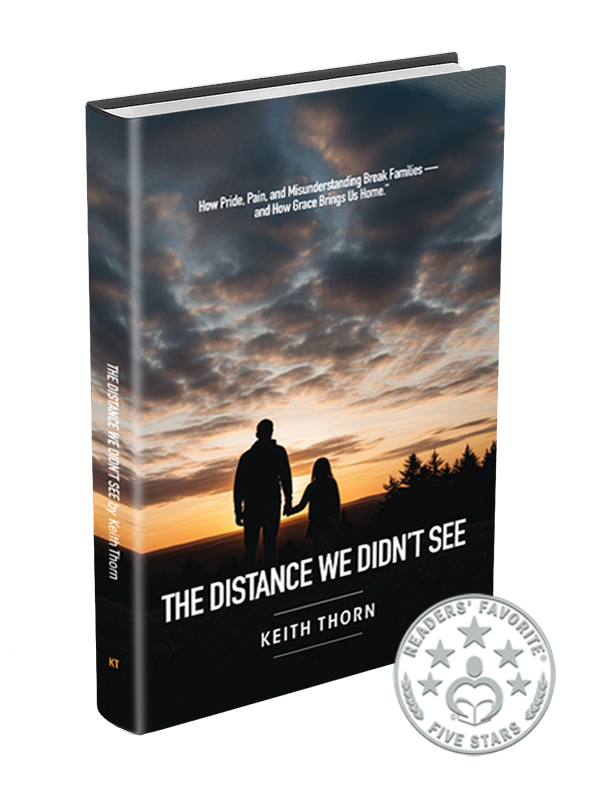
The Distance We Didn’t See is a deeply vulnerable reflection on family estrangement, late-in-life growth, and the quiet hope that grace can outlive the damage misunderstandings create.
Drawing from decades of mistakes, broken marriages, emotional reactions, and the long, slow journey of healing, Keith Thorn writes not as a victim, but as a man who finally understands the distance his children felt—and the distance he never saw. Read More
This isn’t a book of blame or excuses.
It’s a book of responsibility, tenderness, and hard-won clarity.
Through personal reflection and universal truth, Thorn explores:
how expectations fracture relationships
how emotional timelines rarely match
how conditional love hides beneath demands for acceptance
how silence becomes self-protection
and how late growth can still matter, even when no one is there to witness it
Instead of pushing reconciliation, this book offers something deeper: love without pressure, grace without conditions, and the hope that kindness may one day become the bridge that words could not.
For anyone carrying the ache of distance—children, parents, partners—this book is a reminder that love doesn’t always look like agreement, and healing doesn’t always look like reunion.
Sometimes the most powerful love we give…
is the love that waits without closing the door.
Keith Thorn’s The Distance We Didn’t See is an incredibly raw, quiet book that looks at how family rifts actually happen—not usually through one big explosion, but through years of small misunderstandings and unaddressed pride. Thorn is brave enough to look back at his own parenting. He captures that painful reality where a parent’s defensive strength is actually felt by their kids as rejection. The book dives into how we let ego whispers tell us we aren’t appreciated, and how that cycle of conditional love—where approval is traded for falling in line—eventually breaks a family apart. It’s a humble, hopeful book dedicated to his wife, Melody, and is unique because it respects the boundaries adult children set for their own self-preservation without making any demands for a quick fix.
Keith Thorn’s writing itself is poignant and deeply introspective, focusing more on healing than on assigning blame. It doesn’t move fast; instead, the pace feels more like a slow thaw, building through chapters that examine how kindness can eventually outlast a disagreement. I was really moved by the quiet action in these pages—the moments where someone decides to pause mid-reaction or simply say, “I was wrong,” even when there’s no reply from the other side. Living in Lahore, where our family ties are so tight-knit and complex, Thorn’s perspective on grace felt especially relevant. It’s a nudge to look at those unspoken tensions we all carry and try to soften them before the distance becomes too wide to cross. The Distance We Didn’t See is a beautiful reminder that humility is often the only thing that can actually break a generational cycle.





Mansoor Ahmed –
Keith Thorn’s The Distance We Didn’t See is an incredibly raw, quiet book that looks at how family rifts actually happen—not usually through one big explosion, but through years of small misunderstandings and unaddressed pride. Thorn is brave enough to look back at his own parenting. He captures that painful reality where a parent’s defensive strength is actually felt by their kids as rejection. The book dives into how we let ego whispers tell us we aren’t appreciated, and how that cycle of conditional love—where approval is traded for falling in line—eventually breaks a family apart. It’s a humble, hopeful book dedicated to his wife, Melody, and is unique because it respects the boundaries adult children set for their own self-preservation without making any demands for a quick fix.
Keith Thorn’s writing itself is poignant and deeply introspective, focusing more on healing than on assigning blame. It doesn’t move fast; instead, the pace feels more like a slow thaw, building through chapters that examine how kindness can eventually outlast a disagreement. I was really moved by the quiet action in these pages—the moments where someone decides to pause mid-reaction or simply say, “I was wrong,” even when there’s no reply from the other side. Living in Lahore, where our family ties are so tight-knit and complex, Thorn’s perspective on grace felt especially relevant. It’s a nudge to look at those unspoken tensions we all carry and try to soften them before the distance becomes too wide to cross. The Distance We Didn’t See is a beautiful reminder that humility is often the only thing that can actually break a generational cycle.