
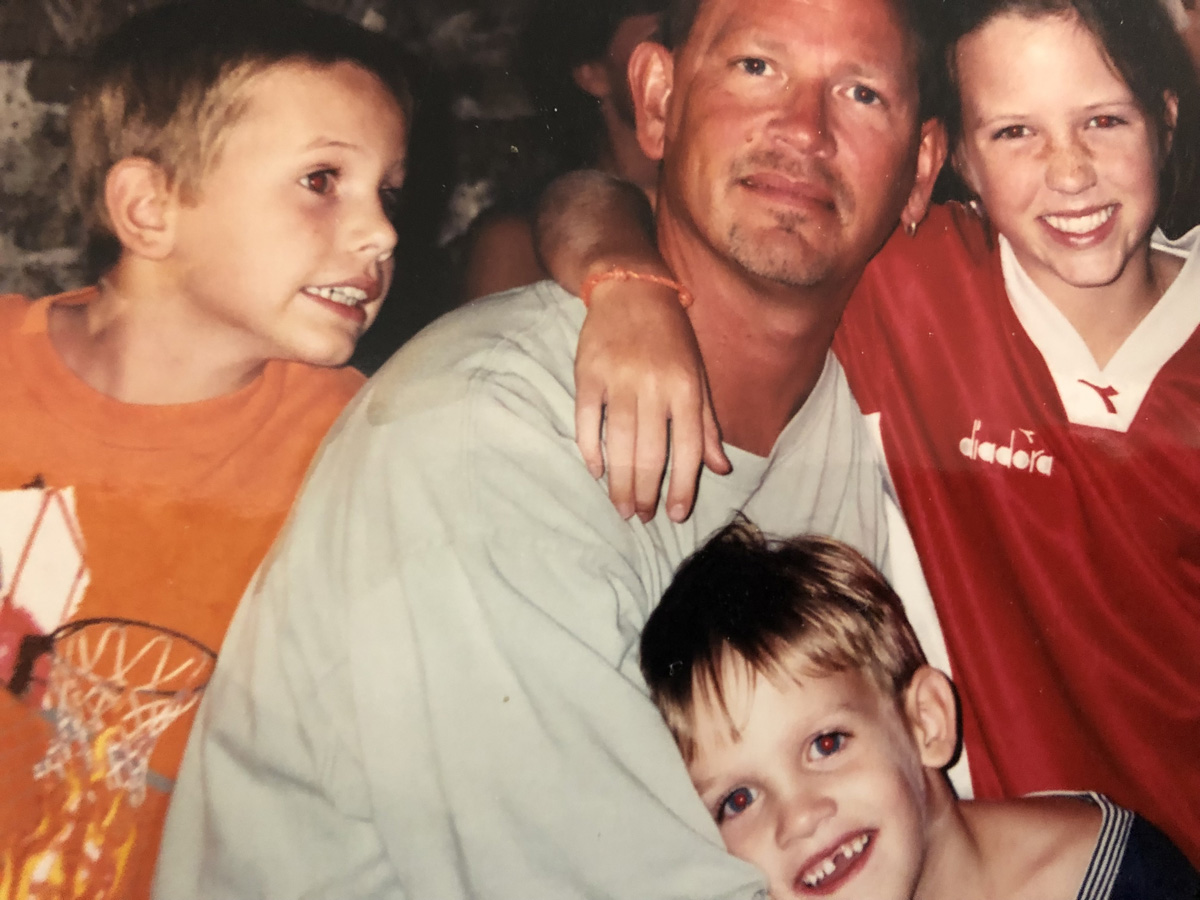
Nietzsche once wrote, “Whoever fights monsters should see to it that in the process he does not become a monster.” I understood the idea when I first encountered it, but I don’t think I understood the warning. Not really. It took decades for me to realize that sometimes the people we most desperately insist we will never become are the very people around whom we build our lives. We run from them, rebel against them, measure ourselves against them, and sometimes hate them so intensely that we never notice they are still determining the direction we travel.
I think this is particularly dangerous for men and their fathers. You can spend half your life saying, I will never be like him, without realizing that he is still the standard against which you are measuring yourself. Imagine your father was a 1 on some imaginary scale from 1 to 100. You become twice as responsible, twice as loving, twice as present, and congratulate yourself for becoming a 2. You may indeed be twice the man he was, but you’re still living at the bottom of the scale. The problem wasn’t simply that your standard was too low. The problem was allowing another man’s failures to remain your standard at all.
There is another uncomfortable truth in this. We are made, in part, from the people we came from. We may inherit their eyes, their hands, their mannerisms, perhaps their tempers or their fears. We can reject what they did without pretending none of it lives somewhere within us. And when that rejection becomes hatred, it can begin working on us in ways we don’t recognize. Anger rarely stays neatly contained inside the box marked the person who hurt me. It leaks. It finds relationships, habits, appetites, and eventually people who had nothing to do with the original wound.
I know because, from about eighteen until thirty-three, I was on a remarkably self-destructive path. At the time, I would not have described myself that way. I was living. I was young. I was doing what young men do—or at least that was the explanation I gave myself. Looking backward, though, I can see how much anger was hiding beneath the excess. Some of the things I did were not rebellion against my father at all. They were punishment inflicted upon myself because of what my father had done to me. I believed I was carrying hatred for him when, much of the time, I was the one paying the bill.
My biological father had left before I was born. Within a couple of years he had remarried and continued with another life, while the life he helped create unfolded without him. He never paid a cent toward my well-being in child support. He didn’t know the boy I became or much of anything about what happened to me. He didn’t know that when I was two years old I became gravely ill and nearly died. He missed the birthdays and ordinary afternoons, the mistakes and accomplishments, all those thousands of small moments through which a father eventually knows his son. I had thirty-three years to build a case against him, and by the time I finally decided to meet him, the prosecution was well prepared.
This is also why I have come to think differently about the biblical instruction to honor our parents. I don’t believe honor requires us to pretend that harmful things weren’t harmful. It doesn’t mean returning to abuse, abandoning boundaries, or rewriting history so that somebody else can feel better about it. But perhaps Scripture understands something about generational destruction that we often learn too late: hatred can become an inheritance every bit as real as money, property, or a family name. One generation wounds another, that wound is carried forward, and eventually somebody who had nothing to do with the original injury begins bleeding from it.
That idea eventually found its way into my book Our Bad Choices. We like to imagine our worst decisions are private because we make them privately. They aren’t. Our choices ripple outward. Addiction reaches spouses and children. Anger changes the atmosphere of a home. Abandonment alters people who may not even have been born when the first decision was made. Resentment can travel through a family for generations until nobody remembers exactly where it began. Someone simply has to decide that it has traveled far enough.
When I was thirty-three, I boarded a plane for Dallas to meet my biological father. I would love to tell you that I went there seeking reconciliation, carrying grace in my heart and hoping to understand him. That would make a beautiful story, but it wouldn’t be true. Somewhere beneath my stated reasons for going was something much uglier. I was prepared to “whoop his ass.” I knew—or thought I knew—that sooner or later he would disappoint me. He would say something dismissive, selfish, or careless, and thirty-three years of anger would finally have permission to come out.
In some strange way, I needed him to fail one more time.
Then he spoke first.
He told me he was sorry, and then he told me that he loved me.
Those were not the words I had prepared myself to hear. Anger knows what to do with excuses. It knows what to do with denial, arrogance, indifference, and blame. I had rehearsed responses to all of those possibilities. But I had never rehearsed a response to I’m sorry. I certainly hadn’t prepared myself for I love you.
Part of me wanted to challenge the absurdity of it. How could you love a son you had abandoned before he was born? How could you love someone whose childhood you never witnessed, whose mother you never helped support, whose illnesses you knew nothing about, whose life had unfolded almost entirely beyond your sight? I could have spent the afternoon presenting evidence, and every piece of it would have been true.
But something else was happening in that room, something I wouldn’t fully understand until much later. My father had spoken first, and by doing so, he had won something. Not against me. For himself. He had finally stepped toward the thing he had spent years living away from. His apology could not recover my childhood or transform absence into fatherhood, but it allowed him to put down some portion of the guilt he had been carrying.
Then it was my turn to speak, and in answering him I discovered that there was something for me to put down too.
That was my victory.
I didn’t win because I defeated my father, frightened him, humiliated him, or finally made him hurt as much as I believed I had hurt. I won because, for the first time, I understood that destroying him would not repair me. His apology gave him somewhere to place his guilt, and my response gave me somewhere to place my anger. Neither of us could change the thirty-three years behind us, but in a few minutes we changed the direction in which we would carry them.
Something in my life shifted after Dallas. I was no longer as interested in defeating the man who had abandoned me because I was beginning to recognize how much power I had given him by continuing to fight him. A father who had barely been present in my childhood had somehow remained enormously present in my anger. His absence had already taken enough years from me. I finally understood that I did not have to volunteer the rest.
That is what I would tell younger men now. Be careful about using the worst man in your life as the measuring stick for the man you intend to become. Don’t merely become a better father than your father; become the father your children need. Don’t simply become a better husband than the husbands you watched growing up; learn to love the woman beside you well. Don’t spend your life proving you are nothing like him, because even rebellion can become a strange kind of captivity when the person you’re rebelling against continues determining your direction.
And perhaps there is something hidden in two very ordinary words that I had never considered before: met and meet. They are almost the same word. One describes what has already happened, while the other holds open the possibility of what still could. Yet both require the same thing. Someone has to step forward. Someone has to cross whatever distance exists between two people. Someone has to risk hearing what he doesn’t want to hear and saying what pride, fear, or shame has kept him from saying.
My father stepped forward first that day in Dallas. He became the man willing to say, I’m sorry.
Then I stepped forward. I became the man willing to hear it without demanding that thirty-three lost years somehow be returned before I would put down my anger.
Perhaps that is one of the passages into manhood we don’t talk about enough. We teach boys to stand their ground, but there comes a time when a man must also know when to cross it. Sometimes courage means apologizing before someone demands an apology. Sometimes it means forgiving without pretending the wound never existed. Sometimes it means telling the truth without sharpening it into a weapon. And sometimes it means recognizing that the anger which once protected you has begun imprisoning you.
I flew to Dallas believing I was going there to finally meet the man I had spent much of my life hating. I didn’t know that I was also going there to meet a different version of myself.
Two men walked toward each other that day. One spoke first and began laying down his guilt. The other spoke second and began laying down his anger. Neither could undo what had happened, and neither could recover the years already gone. But both could decide what would happen to the pain next.
Maybe that is the real choice eventually placed before every man who has been wounded by another man. We don’t get to choose everything handed down to us. We cannot rewrite our childhoods or force another person to become who we needed him to be. But we do get to decide whether the wound becomes an inheritance we pass along.
The bravest thing a man may ever do is not defeat the monster he has spent his life fighting. It may be stepping forward far enough to make certain the monster goes no farther.